Functions — Contract Actions
Next, Alex moves on to functions:
— "Variables are the passive part. Functions are the active part. They're like buttons. You press them — and something happens."
Terms
Function — a block of code that performs a specific task. Can accept input parameters and return a result. Functions allow users to interact with the contract and change its state. A function can be called in a transaction on the blockchain.
Function parameters — input data that a function receives to work with. Each parameter has a type and name. They allow passing information to the function for processing.
Return value — data that a function gives as the result of its work. Specified using the
returns keyword and data type.Pure function — a function that doesn't read or modify the contract's state. Performs only calculations with passed parameters. Marked with the
pure modifier.View function — a function that can read the contract's state but cannot modify it. Used to retrieve data without creating transactions. Marked with the
view modifier.Payable function — a function that can receive cryptocurrency payments along with the call. Marked with the
payable modifier. Received funds are added to the contract's balance.What is a Function?
Alex thinks about the concept of a function:
— "A function is like a 'black box'. You give it input data, some manipulations happen inside, and you get a result at the output. I don't need to know how exactly it works inside — the main thing is to understand what task it solves and what result it returns."
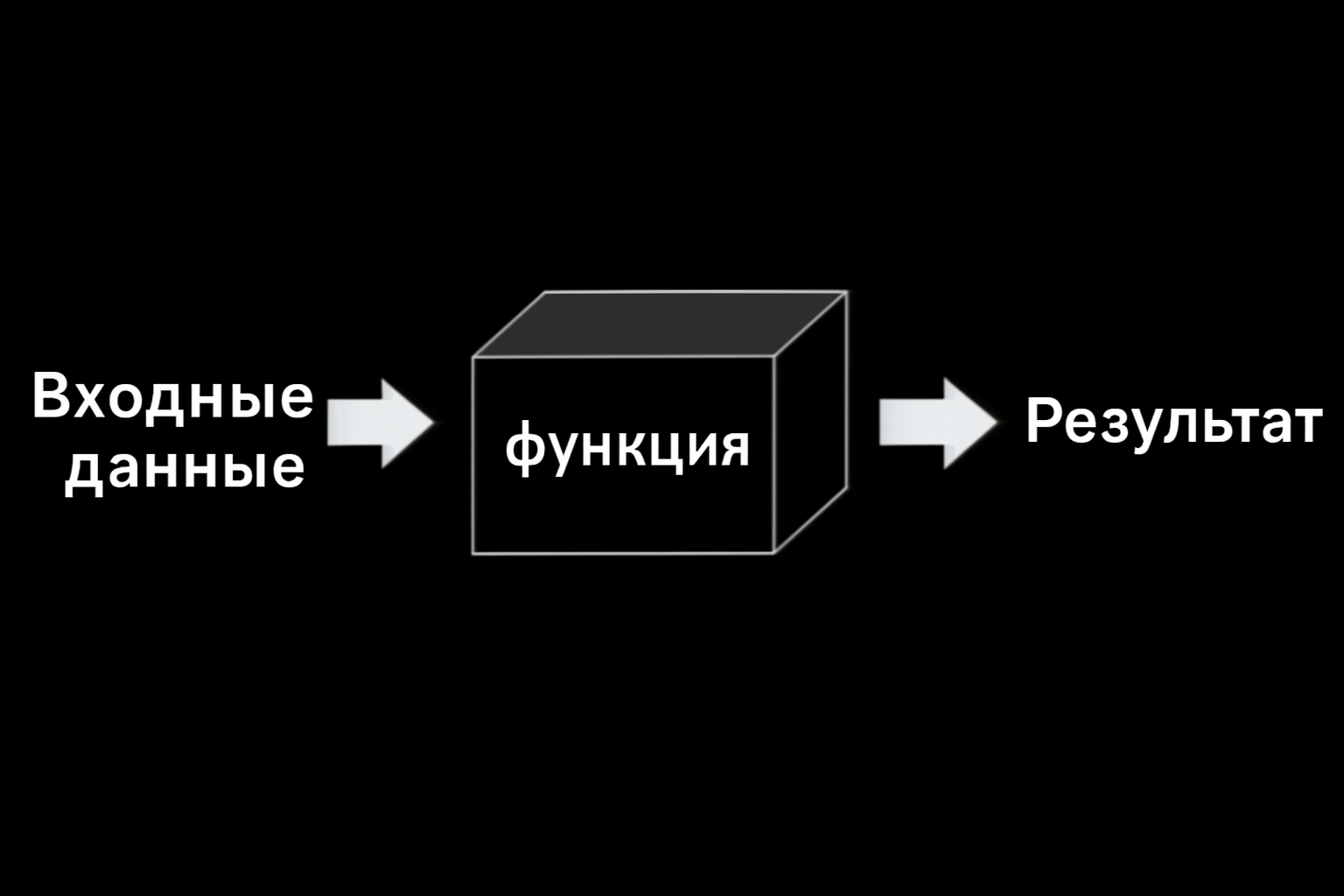
For example, when Alex calls the function
multiply(5, 3), he knows he will get 15, but he doesn't necessarily need to know how exactly the multiplication happens inside the function.Function Declaration
Function declaration begins with the keyword
function. Then the function name and parameters in parentheses. Then visibility modifiers, followed by the return type.Let's break down the function piece by piece:
Function Structure in Solidity
Alex studies the anatomy of a Solidity function:
1. Function Name
— "The name should clearly describe what the function does.
calculateArea is better than just calc."2. Parameters (Input Data)
— "This is data that the function receives to work with. Each parameter has a type and name."
3. Visibility and Behavior Modifiers
— "They define who can call the function and its behavior type. If not specified, default modifiers will be used."
4. Return Type
— "This is the data type that the function returns as the result of its work."
5. Function Body
— "Here the logic is described — what exactly is executed when the function is called."
Why Do We Need Functions?
Alex understands that functions solve several important tasks:
1. Code Organization
— "When code is broken down into functions, each performing one small task, it's much easier to understand and maintain."
2. Simplified Understanding
— "I don't need to know how a function works inside. The main thing is understanding what it does. It's like using a calculator: it doesn't matter how it's built, what matters is that it calculates correctly."
3. Reuse
— "If I need to do the same actions in different parts of the program, I can write one function and use it many times."
Function Features in Blockchain
Alex asks an important question:
— "How do functions in blockchain differ from regular functions in other programming languages?"
After studying the documentation, he understands the key differences:
1. Connection with Transactions
In blockchain, each function call that changes the contract state creates a transaction:
- State-changing functions (without
view/pure) → create a transaction, cost gas, changes are written to blockchain forever
- View/Pure functions → executed locally, free, don't create transactions
2. Execution Cost
— "In regular programs, a function executes for free. In blockchain, you need to pay gas for changing data!"
3. Irreversibility
— "In a regular program, you can roll back changes or restart. In blockchain, every change is recorded forever!"
4. Publicity
— "Any blockchain participant can look at the function code and call public functions. In regular programs, code is often hidden."
The memory Keyword — Where to Store Data?
Alex notices something strange in the code:
— "Why does
string always have string memory written, but uint256 doesn't? What is this memory?"He studies the documentation and understands: in Solidity there are different "places" for storing data, like different shelves in a store.
Data Storage Locations:
storage— permanent storage (like a database field) — data is saved in the blockchain forever
memory— temporary storage (like RAM in a computer) — data exists only during function execution, you can read and write temporary information
calldata— read-only (like a computer disk without write capability) — data is passed to the function, cannot be changed and is not saved after function execution
Which Types Require memory?
The
memory keyword needs to be specified only for complex data types:✅ Require
memory:string— strings
bytes— byte arrays
- arrays (
uint256[],address[], etc.)
- structures (
struct)
❌ Do NOT require
memory:uint256,int256— numbers
bool— boolean values
address— addresses
Why Does This Happen?
Alex understands the logic:
— "Simple data types (numbers, addresses) have a fixed size — they always take the same amount of space. The compiler knows where to put them."
— "Complex data types (strings, arrays) have variable size — a string can be 5 characters or 500. Therefore, you need to explicitly specify where to store them."
Examples of Correct Usage:
Visibility and Behavior Modifiers
In function declaration there's an important part — modifiers:
— "Modifiers are like 'access settings' for functions. They define two important things: who can call the function (visibility) and how it interacts with blockchain data (behavior)."
He studies two categories of modifiers:
- Visibility modifiers (
public,private,internal,external) — define where the function can be called from
- Behavior modifiers (
view,pure,payable) — define how the function works with contract state
— "Understanding modifiers is critical. Wrong visibility can open security vulnerabilities, and wrong behavior can lead to unexpected gas costs."
Visibility Modifiers
Alex studies who can call functions:
public - everyone can call
Functions are accessible to everyone: users, other contracts, and inside the contract itself.
Examples of functions usually made public:
private - only functions in the same contract can call
Accessible only inside this contract. Even inheriting contracts don't have access.
Examples of functions usually made private:
internal - functions in the same contract and inheriting contracts can call
Accessible inside the contract and in inheriting contracts. Not accessible from outside.
Examples of functions usually made internal:
external - can only be called from functions in other contracts
Accessible only from outside the contract. Cannot be called from inside the contract itself. More economical than
public for large data.Examples of functions usually made external:
Important Difference: Visibility Modifiers for Variables vs Functions
Alex notices an important feature:
— "Wait! The
public modifier for functions doesn't work the same as for variables!"He studies the documentation and understands the key difference:
For variables
public = automatic getter, allowing reading the variable from outside the contractFor functions
public = ability to call the function from outside the contract, by users or other contractsImportant conclusion: The visibility modifier of a function has significantly greater importance for contract security than the visibility modifier of a variable. Wrong function visibility can open critical vulnerabilities — for example, if a private administrative function is accidentally declared as
public, attackers will be able to call it. While wrong variable visibility most often leads only to unwanted data disclosure, but not to loss of contract control.Behavior Modifiers
Behavior modifiers define how a function interacts with contract data and blockchain:
— "It's like different operating modes. Some functions can do everything — read, write, receive money. Others — only read. And third ones — don't access anything at all, only calculate."
view - read-only data
Functions can read data from the blockchain but cannot change it. Free when called directly, not from another function.
Examples of view functions:
pure - no state access
Functions don't read or change contract data. Work only with passed parameters.
Examples of pure functions:
payable - can receive payments
Functions can receive ETH — blockchain currency along with the call. Without
payable, sending ETH will result in an error.Examples of payable functions:
Comparing Behavior Modifiers
Alex creates a table for better understanding:
Modifier | Read State | Change State | Receive ETH | Gas Cost | Creates Transaction |
|---|---|---|---|---|---|
view | ✅ Yes | ❌ No | ❌ No | 0 (free) | ❌ No |
pure | ❌ No | ❌ No | ❌ No | 0 (free) | ❌ No |
payable | ✅ Yes | ✅ Yes | ✅ Yes | Has cost | ✅ Yes |
Regular | ✅ Yes | ✅ Yes | ❌ No | Has cost | ✅ Yes |
Practical Example: Token Sale Contract
Alex decides to create a complete example that will show all studied modifiers in action. He develops a contract for token sales:
— "Great idea! I'll make a contract where users will be credited with internal balance for deposited ETH. All modifiers will be useful here:
pure for calculations, view for checking balances, payable for receiving payments!"Combining Modifiers
Alex understands that modifiers can be combined:
Examples of Different Function Types
Alex tries to create different types of functions:
Pure Functions (Pure Calculations)
View Functions (Data Reading)
State-Changing Functions
Payable Functions (Receiving Payments)
He writes the first example:
Now any user can call the
setMessage function and change the message in the contract. The contract can not only store the message, but also change it, and also return the current value.A Contract You Can Interact With
Alex gets inspired and decides to try adding interaction. He wants anyone to be able to change something in the contract. For example, increment a counter:
— "Now my contract works like a visitor counter. Any user can call the incrementCounter() function and report that they visited the site!"
He smiles:
— "Without functions, a contract is like a museum. You can look, but you can't touch anything. With them, it becomes a real tool."
Alex decides to try deploying the contract to the blockchain to see how it works. The contract was deployed at address 0xcF62FF514e60f05eA36c3e7D27AB51932a61599A. Alex went to look at etherscan to see what it looks like – https://sepolia.etherscan.io/address/0xcF62FF514e60f05eA36c3e7D27AB51932a61599A#code.
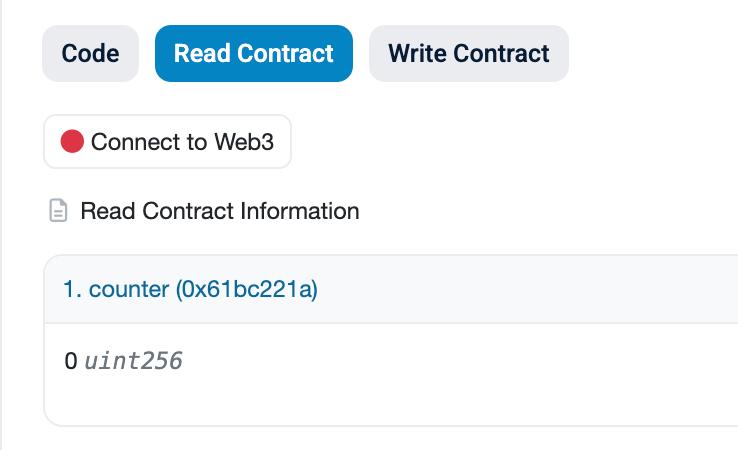
On the page he saw a lot of interesting things. There was the contract code described and lots of different information. But the most interesting was in the Read Contract and Write Contract tabs.
In Read Contract he saw the counter variable and its value, which was equal to 0.
In Write Contract he saw the
incrementCounter function and a button to call it.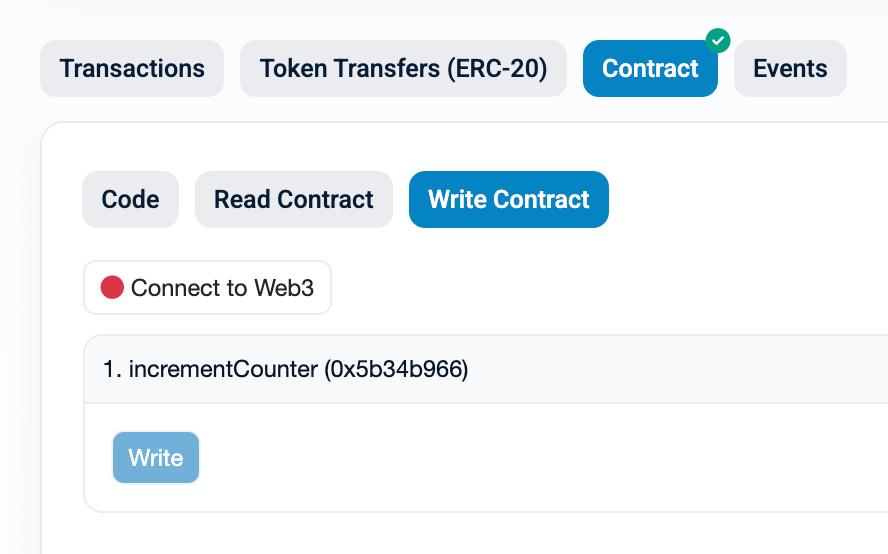
By clicking the Write button, a transaction to the contract will be created to execute the
incrementCounter function and the counter variable value will increase by 1.Practical Assignment
Now Alex wanted to combine everything he learned:
— "I want to implement a contract that will store a value — a counter. Anyone can add one to it. Or subtract. Or reset it."
Alex sat down to write code intensively. After several hours he finally finished. Overjoyed, he jumped up from his chair and knocked over coffee on his laptop. Part of the code was lost. What a horror!
Help Alex fix the broken counter. Your task is to fix the contract with a counter variable and functions.
Практические задания
Загрузка...
Additional Materials
Official Documentation
- Solidity Documentation - Functions — complete guide to functions in Solidity
- Solidity Documentation - Data Location — explanation of storage, memory and calldata